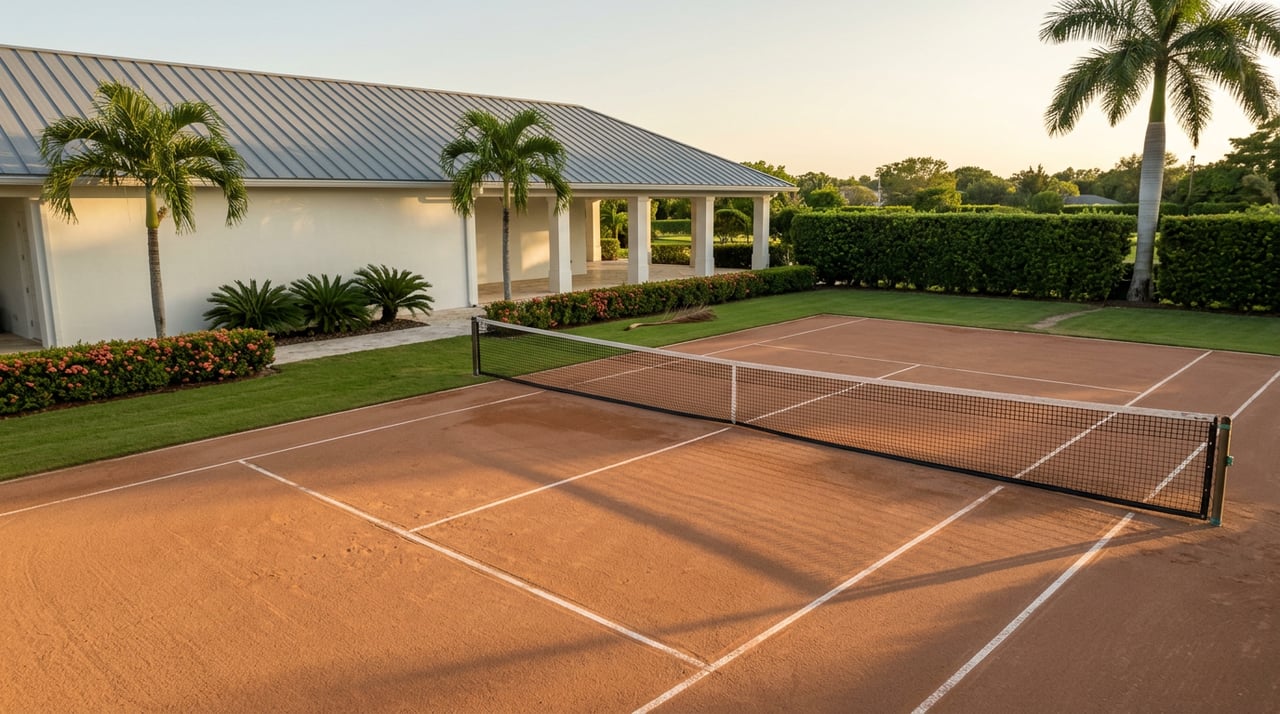
Walk up to Pelican Bay Community Park on a Tuesday morning and you will find eight tennis courts filled with sound, players in the middle of drills, and lights still humming from an early match. Roll past to the pickleball side and it looks much the same, paddles cracking against balls on all twenty courts. The park at 764 Vanderbilt Beach Road just went through a $6 to $7 million transformation, funded almost entirely by the Pelican Bay Foundation. What most residents walking through the gates do not realize is that half of every pickleball court's operating hours belong to the public by law, and no future Foundation board can vote that away.
That detail matters more than it sounds. This is not a private club amenity dressed up as a neighborhood perk. It is a Collier County park that Pelican Bay happens to fund and run, and the terms of that arrangement were locked in before a single court was resurfaced.
Why the Courts Sit Outside the Gates
The park itself predates the current deal by decades. Developer WCI deeded the nearly 15-acre site to Collier County in 1994 as part of an agreement that let the company build more densely elsewhere across the 6,500-home community. For thirty years, the park sat largely untouched, drainage problems and aging surfaces limiting play on courts that had not been meaningfully updated since the 1990s.
The Foundation's interest in changing that dates back nearly a decade before construction ever began, when it first approached the county about buying the park back outright. The county said no. Years later, after the Foundation ran into resistance from neighbors when it tried to find room for new courts inside Pelican Bay's own boundaries, it returned to the county with a different pitch: let us invest in your park instead. That is the deal that eventually produced the complex standing today, and it explains why the neighborhood's newest amenity sits on public land rather than behind a private gate.
The Rule That Outlasts the Investment
On February 13, 2024, the Pelican Bay Foundation and the Collier County Board of County Commissioners approved an amendment that governs exactly how the pickleball courts get used. The language is direct: members of the public get access to half the pickleball courts during the same days and hours as Foundation members, and no more than half can be reserved for Foundation use at any time.
That 50/50 split was not a courtesy extended by the Foundation. It was a condition of building on county land, and it applies regardless of how much money Pelican Bay puts into the facility going forward. Ten of the twenty courts are designated for Foundation residents. The other ten stay open to any public player willing to pay $10 for a day pass or $95 for an annual membership, the same rate whether they live inside Pelican Bay or drove over from East Naples.
Foundation President Tony D'Errico acknowledged the pressure of building on a timeline the county was watching closely. Speaking to commissioners about the design delays before construction began, he put it plainly:
"We'd like to have our shovels in the ground in December and be playing pickleball sometime in June."
Groundbreaking happened that December, on the 6th, 2024. Construction ran longer than the summer target, and the courts opened to players in December 2025, more than a year after the first shovel went into the ground.
What the Money Actually Built
The pickleball side got 20 Novacrylic courts where racquetball and handball courts used to sit, along with a new building housing a pro shop, maintenance space, restrooms, and a shaded area for players waiting their turn. The tennis side kept its six existing Har-Tru clay courts but rebuilt them from the ground up, added two brand-new standalone courts, and installed lighting across all eight, turning them into sub-irrigated, hydro-grid surfaces that drain properly for the first time in years. That tennis-specific piece of the project drew support from a USTA Tennis Venue Services grant on top of the Foundation's own investment.
Beyond the courts, the project increased parking to 109 spaces, relocated the old baseball and softball practice area, rebuilt the playground to ADA standards, and added a 12-foot sound-absorbing wall between the pickleball courts and the closest homes in Avalon and Breakwater, two of the Pelican Bay neighborhoods whose residents had been driving to the park to play on converted racquetball courts before any of this existed.
Running it all now costs the Foundation roughly $400,000 a year, covering staffing, resurfacing, lighting, and a court ambassador whose job is managing the daily rotation between public and Foundation play.
Since the Grand Opening
Pelican Bay marked the completed project with a public grand opening on February 16, 2026, drawing pickleball demonstrations, professional exhibition matches, and a panel discussion featuring Michelle McMahon, an Emmy Award-winning sportscaster for PBTV, Tennis Channel, and Fox Sports, on the growth of racquet sports in Southwest Florida. A $10 tournament ran alongside the ceremony.
Seven months later, the numbers tell a clear story about demand. The eight tennis courts now stay booked most of the day, with roughly 200 players cycling through on a typical week according to USTA Florida's reporting this past May. Head Professional Tatianna Batalla has built out youth programming that USTA Florida credits with drawing kids back to the sport, and USTA League Play has returned to the park after competitive players had been driving elsewhere for years while the old courts sat neglected. Maury Bozman, the park's Director of Community Center and Racquets, described the shift as taking "a tired facility from the 90's" and turning it into a destination for locals and visiting players alike.
For context on scale, East Naples Community Park still has more pickleball courts overall, 65 of them, and hosts the U.S. Open Pickleball Championships each spring. Veterans Community Park runs 16 self-managed courts a few miles south. Pelican Bay's 20 courts do not compete with East Naples on volume, but they are the only pickleball courts inside a four-mile radius that serves roughly 40,000 people a year, according to county figures cited during the project's approval process, making this the largest green space west of U.S. 41.
What This Looks Like on a Given Week
If you are trying to get a game in, the practical details are these:
- Pickleball courts run 8 a.m. to dusk, seven days a week
- Tennis courts run 8:30 a.m. to 9 p.m., seven days a week
- Public pickleball access costs $10 for a single day or $95 for an annual pass
- Ten of the twenty pickleball courts are reserved for Foundation residents at any given time, the other ten for public players, per the county-approved schedule
- Court reservations for both sports go through the park's own booking system rather than a private club portal
None of that changes based on who lives closest to the gate. The county owns the ground, the amendment governs the split, and the Foundation's role is to keep the lights on and the surfaces playable, not to decide who gets priority.
The Quiet Trade
What makes this arrangement interesting is not the dollar figure or even the court count. It is the fact that Pelican Bay chose to pour millions into a facility it will never fully control, because the alternative, building inside its own boundaries, ran into resistance from the very residents who might have used it most. The result is a park that reads as a neighborhood amenity in every practical sense, morning games, familiar faces, a pro shop that knows your name, while remaining legally tethered to public access in a way that few residents think about until they show up expecting the whole place to themselves.
That tension is worth understanding if you already call Pelican Bay home. It shapes who you will share a court with on a Saturday morning, and it is part of what makes this particular stretch of North Naples feel different from communities that kept their racquet facilities entirely behind their own gates.
If you are curious how amenities like this factor into property values or day-to-day life across Pelican Bay's different neighborhoods, Sandra Edwards has spent 25 years watching how details like a shared court schedule shape the way people actually live here. Let's Connect.